 Overview
  FAQs
FAQs  Research Feed
  Update History
  References
 2025-02-05 06:47:26
Page Creation majorBlood-Brain Barrier page created by Karen Pendergrass

Did you know?
The blood-brain barrier is so selective that it prevents around 98% of small-molecule drugs from reaching the brain. However, certain bacteria and viruses, like Listeria monocytogenes and Neisseria meningitidis, have evolved mechanisms to bypass it, leading to severe brain infections.
Researched by:

The BBB is a crucial regulatory interface between the circulatory and central nervous systems, and its dysfunction has profound implications for neurodegeneration, inflammation, and systemic disease. Increasing evidence supports the role of the gut microbiome in BBB modulation, highlighting microbiome-targeted therapies as a promising avenue for maintaining neurological health and preventing age-associated cognitive decline.
Researched by:
Microbiome Signatures identifies and validates condition-specific microbiome shifts and interventions to accelerate clinical translation. Our multidisciplinary team supports clinicians, researchers, and innovators in turning microbiome science into actionable medicine.

The blood-brain barrier (BBB) is a highly specialized and dynamic compartment that regulates the uptake of molecules and solutes from the blood. It is established by brain endothelial cells and plays a crucial role in protecting the brain from exogenous components and xenobiotics. The BBB restricts immune cell entry into the central nervous system (CNS) and has an active role in neurovascular coupling, regulating cerebral blood flow to support neuronal activity. Damage to the BBB can lead to an influx of deleterious molecules into the CNS, accelerating leakage across the barrier. Thus, the BBB is a critical component of the brain’s defense system, and its disruption is a common aspect in various neurodegenerative and neurodevelopmental diseases. [1][2]
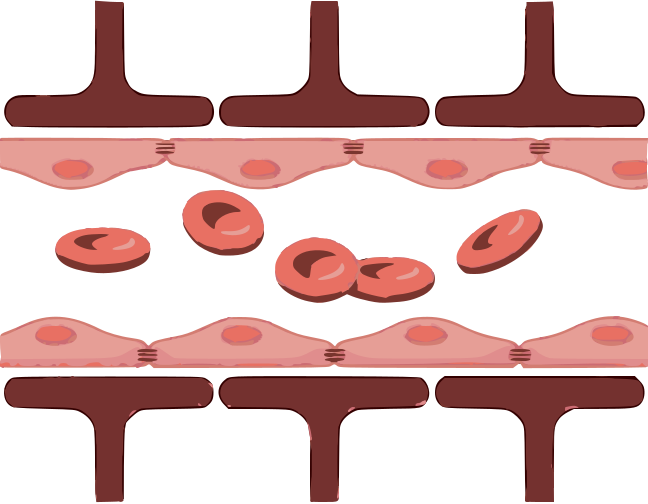
The BBB is a highly specialized and dynamic compartment that regulates the uptake of molecules and solutes from the blood. It is composed of brain endothelial cells that form a tight monolayer, restricting the passage of substances into the brain. These endothelial cells are connected by tight junctions, such as ZO-1, which are essential for maintaining BBB integrity. Pericytes, contractile cells that surround the endothelial cells, contribute to the regulation of blood flow and permeability. Astrocytes, star-shaped glial cells, play a crucial role in maintaining the BBB by modulating endothelial cell activity and regulating the expression of tight junction proteins. [1][2]
The blood-brain barrier regulates the trafficking of molecules and solutes from the blood into the brain, selectively restricting the entry of pathogens and toxins while permitting the passage of essential nutrients and hormones. It also plays a crucial role in neurovascular coupling by regulating cerebral blood flow to support neuronal activity. Additionally, the BBB contributes to the clearance of neurotoxic agents, including the removal of amyloid-β, which is implicated in Alzheimer’s disease. Beyond its protective functions, the BBB is actively involved in immune regulation by restricting the entry of immune cells into the brain and modulating immune activity within the central nervous system. [1][2]
Metal ions play a crucial role in maintaining the integrity of the blood-brain barrier (BBB). The BBB is a selective barrier that separates the brain from the bloodstream, and metal ions can affect its function and permeability. Excess metal ions, such as iron, can accumulate in the brain and disrupt the BBB, leading to increased permeability and the entry of toxic substances into the brain. This can contribute to neurodegenerative diseases, such as Alzheimer’s and Parkinson’s, as well as stroke and epilepsy. The regulation of metal ion homeostasis is essential for maintaining the integrity of the BBB and preventing metal-induced neurotoxicity. [3][4]
The gut microbiome also plays a crucial role in maintaining the integrity of the blood-brain barrier. Research has shown that the gut microbiome influences the BBB through various mechanisms, including the production of microbial metabolites that interact with the BBB. These metabolites can modulate the expression of genes involved in BBB function, such as LRP-1 and NRF2, and can also affect the permeability of the BBB. Dysbiosis of the gut microbiome has been linked to increased BBB permeability, which can lead to the entry of inflammatory molecules and toxins into the brain, contributing to neurodegenerative diseases. The gut microbiome’s influence on the BBB is a key aspect of the gut-brain axis, a bidirectional communication network between the gut and the brain. [5][6][7]
Microbial Metallomics plays a critical role in understanding the relationship between microbial interactions, metal homeostasis, and the integrity of the blood-brain barrier. The BBB is vulnerable to disruptions caused by microbial and metal interactions, which can contribute to neuroinflammation, neurodegeneration, and cognitive dysfunction. Many neuroinvasive pathogens, such as Neisseria meningitidis and Escherichia coli K1, exploit iron acquisition mechanisms like siderophore-mediated scavenging to breach the BBB, leading to CNS infections and inflammation. Similarly, dysregulated zinc transport across the BBB is implicated in neurodegenerative conditions such as Alzheimer’s and Parkinson’s disease, with gut microbiota capable of zinc sequestration altering its availability in the brain, further exacerbating pathology. Copper also plays a role in microbial neuroinvasion, as seen in Cryptococcus neoformans, an opportunistic fungal pathogen that utilizes copper resistance mechanisms to persist in the CNS, particularly in immunocompromised individuals. Additionally, chronic exposure to heavy metals such as lead and cadmium alters microbiome composition, promoting metal-resistant microbial strains that compromise BBB integrity, which has been linked to cognitive impairment and neurodevelopmental disorders. [8]
Microbiome-targeted strategies for gut-brain barrier maintenance focus on modulating the microbiome to support integrity and reduce inflammation. Probiotics like Lactobacillus and Bifidobacterium promote balance, while prebiotics nourish beneficial bacteria. Synbiotics combine both to enhance microbial stability. Fecal Microbiota Transplantation (FMT) restores microbiome equilibrium in dysbiosis, and gut-directed psychobiotics, such as Bifidobacterium longum 1714, influence the gut-brain axis, alleviating anxiety and depression-like behaviors. [9] Chelation therapy offers a novel approach for oxidative stress and iron accumulation, with iron chelators like deferiprone showing promise in delaying neurodegeneration. [10] Together, these strategies provide potential therapeutic avenues for improving gut-brain barrier function and reducing neuroinflammation.
Did you know?
The gut microbiome produces over 90% of the body’s serotonin, a key neurotransmitter that regulates mood, sleep, and cognition.
Alias iure reprehenderit aut accusantium. Molestiae dolore suscipit. Necessitatibus eum quaerat. Repudiandae suscipit quo necessitatibus. Voluptatibus ullam nulla temporibus nobis. Atque eaque sed totam est assumenda. Porro modi soluta consequuntur veritatis excepturi minus delectus reprehenderit est. Eveniet labore ut quas minima aliquid quibusdam. Vitae possimus fuga praesentium eveniet debitis exercitationem deleniti.
2025-02-05 06:47:26
Page Creation majorBlood-Brain Barrier page created by Karen Pendergrass
2025-02-04 08:28:07
Blood-Brain Barrier (BBB) majorpublished
Parkinson’s disease is increasingly recognized as a systemic disorder involving coordinated disturbances across the gut–brain axis, rather than a condition confined to dopaminergic neurodegeneration alone. Converging evidence implicates gut dysbiosis, altered microbial metabolites, impaired intestinal barrier integrity, and metal dyshomeostasis as upstream drivers of neuroinflammation and alpha-synuclein pathology. These interconnected microbiome, metabolomic, and metallomic signals provide a mechanistic framework for understanding disease initiation, progression, and therapeutic targeting beyond the central nervous system.
Microbial Metallomics is the study of how microorganisms acquire, use, regulate, and transform metals in any biological or environmental context.
Parkinson’s disease is increasingly recognized as a systemic disorder involving coordinated disturbances across the gut–brain axis, rather than a condition confined to dopaminergic neurodegeneration alone. Converging evidence implicates gut dysbiosis, altered microbial metabolites, impaired intestinal barrier integrity, and metal dyshomeostasis as upstream drivers of neuroinflammation and alpha-synuclein pathology. These interconnected microbiome, metabolomic, and metallomic signals provide a mechanistic framework for understanding disease initiation, progression, and therapeutic targeting beyond the central nervous system.
Fecal Microbiota Transplantation (FMT) involves transferring fecal bacteria from a healthy donor to a patient to restore microbiome balance.
Brain health encompasses the overall functioning and well-being of the brain, including cognitive function, emotional and psychological well-being, neurological integrity, behavioral health, neurodevelopmental health, age-related brain health, and brain resilience and plasticity.
Aragón-González A, Shaw PJ, Ferraiuolo L.
Blood-Brain Barrier Disruption and Its Involvement in Neurodevelopmental and Neurodegenerative Disorders.Int J Mol Sci. 2022.
Zierfuss B, Larochelle C, Prat A.
Blood-brain barrier dysfunction in multiple sclerosis: causes, consequences, and potential effects of therapies.Lancet Neurol. 2024
Wang S, Qin M, Fan X, Jiang C, Hou Q, Ye Z, Zhang X, Yang Y, Xiao J, Wallace K, Rastegar-Kashkooli Y, Peng Q, Jin D, Wang J, Wang M, Ding R, Tao J, Kim YT, Bhawal UK, Wang J, Chen X, Wang J.
The role of metal ions in stroke: Current evidence and future perspectives.Ageing Res Rev. 2024.
Xia M, Liang S, Li S, Ji M, Chen B, Zhang M, Dong C, Chen B, Gong W, Wen G, Zhan X, Zhang D, Li X, Zhou Y, Guan D, Verkhratsky A, Li B.
Iatrogenic Iron Promotes Neurodegeneration and Activates Self-Protection of Neural Cells against Exogenous Iron Attacks.Function (Oxf). 2021
Lin MS, Wang YC, Chen WJ, Kung WM.
Impact of gut-brain interaction in emerging neurological disorders.World J Clin Cases. 2023
Zhuang M, Zhang X, Cai J.
Microbiota-gut-brain axis: interplay between microbiota, barrier function and lymphatic system.Gut Microbes. 2024
Read ReviewAgnihotri, S.K., Kesari, K.K.
Mechanistic Effect of Heavy Metals in Neurological Disorder and Brain Cancer.Kesari, K. (eds) Networking of Mutagens in Environmental Toxicology. Environmental Science and Engineering(). Springer, Cham. 2019.
Siddhi Bagwe-Parab, Ginpreet Kaur,
Molecular targets and therapeutic interventions for iron induced neurodegeneration.Brain Research Bulletin. 2020.